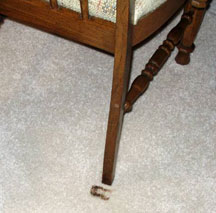
Tabs and blocks prevent bleeding of wood stains and rust from metal objects onto carpet and rug fibers.
ALWAYS place furniture tabs and foam blocks to prevent wood stains!
Don’t end up having to come back to remove YOUR stain on YOUR customer’s carpet! BE A PROFESSIONAL!
Furniture Protector Tabs 5 inches X 10 inches Super Tabs to Prevent Wood and Rust Stains after Carpet Cleaning
(About 1000 per box) Item # 30461
from Bane-Clene® Corp.
ALWAYS place furniture tabs and foam blocks to prevent wood stains like this after cleaning carpet and upholstery. Don’t end up having to come back to remove YOUR stain on YOUR customer’s carpet! BE A PROFESSIONAL!
Wet carpet can cause wood stains or rust if furniture is set directly on it. Furniture and other items with legs must be put on furniture protector tabs after cleaning the carpet or rug. Furniture and other items without legs have to be kept off the carpet with foam blocks to allow the carpet underneath to “breathe” and dry. Tabs and blocks prevent bleeding of wood stains and rust from metal objects onto carpet and rug fibers.
Advise your customer to wait for the carpet to dry completely before removing furniture off of the furniture tabs or blocks. Of course, if your customer is elderly or has physical limitations such as a bad back, volunteer to return to remove the tabs and blocks.
Every carpet cleaning truck should have plenty of furniture tabs, foam blocks, Bane-Glides, Wall Buddy Corner Guards and white turkish spotting towels.
VIDEO: How to Remove Wood Furniture Stains from Carpet
Presentation at a Bane-Clene training class for professional carpet cleaners by Bane-Clene’s chemist on how to Remove Wood Furniture Stains from Carpet
Click the “Usage & Tips” tab above for article on how to maintain leather furniture.
Usage & Tips
LEATHER UPHOLSTERY - How to Clean and Care for
Leather is the ordinary designation of tanned hides and skins.
Leather terms and Types of Leather
Split: All leather hides have to be split into two hides because a hide is too thick to upholster or use in any type of manufacturing. The bottom hide is known as split leather. This hide can be sanded down (corrected) and embossed with a consistent graining pattern to be used on the outside back and sides of sofa for a slight cost savings. A split leather is still 100% leather, and has all the same finishing treatments as the top grain portion.
Top Grain: In the above process the top grain portion is the top portion of the hide. It is generally used in the areas that receive more wear since the fiber of top grain is more compact than that of split grain.
Full Grain: Top grain leather that uses the grain of the hide. No correction is made to the grain.
Embossed Grain: From above, using rollers a consistent graining pattern is “pressed” into the leather. It can be as subtle a small natural looking graining pattern, or as different as a crocodile pattern.
Corrected Grain: This leather is top grain aniline dyed leather. Small natural markings and scars are sanded from the hide and then it is pigment coated for color consistency. Then a clear protective top-coat is applied to prevent fading and stains.
Pull-up: Aniline - dyed leather that has been waxed or oiled. When the leather is pulled, the oil/wax separates, causing the color to lighten.
Cleaning and Care of Pure Anilines and Nu-Buk Leather Upholstery
You’ll notice that leather initially repels most spills, but if left to stand, they’ll be absorbed. That’s why it is important to blot any liquids immediately with a clean cloth or sponge and let air dry. Most spills and stains will dissipate with time. For stubborn spots and stains, blot excess liquid immediately with clean absorbent sponge or cloth. If you need more help, use distilled water and a clean white cloth and let air dry. Use soap sparingly and lots of distilled water. Always test a hidden area to convince yourself of the effectiveness of that method.
LEATHER WILL ABSORB OILS. Appropriate preventative care must be taken to avoid these stains as they may be permanent.
Leather Upholstery Care and Protection
As a general rule, most leather creams, saddle soaps, and various leather care products should not be used. They are not intended for household, upholstered leather.
Dry clean with chemical sponges, and/or towels with solvent. Finish as needed with a cream or oil-based leather cleaner applied by hand.
Simulated Leather (Vinyl/Naugahyde) and non-woven materials made to look like leather should be wet cleaned only. If solvent is used for spotting, it must be used extremely carefully and must not contain any chlorinated solvents.
Upholstery Cleaning, Protection and Maintenance Articles: