How to Get Dog Pee Smell Out of Wood - The Pro Method
Key Takeaways
-
Enzyme cleaners are the only method that fully eliminates dog pee smell from wood - they break down uric acid crystals at the molecular level, while vinegar and baking soda only mask or partially neutralize the odor.
-
Uric acid in dog urine forms microscopic crystals that bind deep into wood grain and reactivate on humid days, which is why the smell often returns after standard cleaning.
-
Acting within the first 5-10 minutes of an accident cuts penetration depth by up to 80%, dramatically reducing how difficult the cleanup will be.
-
A UV/black light is a professional must-have - dog urine is invisible to the naked eye in many cases, so treating only what you can see means leaving active odor sources behind.
-
Unsealed and unfinished wood requires a fundamentally different treatment approach than sealed hardwood floors or lacquered furniture - using the wrong method on the wrong surface can set the stain permanently.
The most effective way to get dog pee smell out of wood is to use a professional-grade enzyme cleaner, applied generously enough to reach the full depth of urine penetration. Blotting immediately, mapping the affected area with a UV light, and allowing adequate dwell time are the steps that separate a permanent fix from a temporary cover-up.
This guide covers each scenario - fresh accidents, old set-in stains, wood floors, and wood furniture - using the same approach professional cleaners use.
Why Dog Pee Smell Is So Stubborn in Wood
Dog urine creates a persistent odor in wood because of uric acid - a compound that resists water, crystallizes deep inside wood fibers, and reactivates with moisture long after the visible stain disappears. Standard household cleaners remove the liquid but leave the crystals behind, which is why the smell keeps coming back.
To understand why the odor is so hard to remove, you need to know what dog urine is made of. It contains urea, uric acid, ammonia, bacteria, proteins, and hormones. Each component plays a different role in the problem. Urea and ammonia produce the immediate sharp smell. Bacteria break down organic matter and amplify the odor over time. But uric acid is the real culprit - and the one most cleaning methods fail to address.

The Uric Acid Crystal Problem
Uric acid does not dissolve in water. When dog urine dries, the uric acid forms microscopic salt-like crystals that adhere to wood fibers and penetrate deep into the grain. These crystals are chemically inert while dry - which is why a floor can smell "clean" for days after an accident - but they reactivate the moment moisture is introduced. This is the biological explanation for the experience nearly every dog owner has had: you clean the spot thoroughly, everything smells fine, and then two weeks later after a humid day, the odor is back.
According to research on uric acid behavior, standard cleaners - including soap, bleach, ammonia-based products, and vinegar - cannot break down uric acid crystals. They clean the surface layer and neutralize some of the ammonia, but the crystals remain embedded in the wood. The odor will return.
How Humidity Reactivates the Odor
Each time the wood surface absorbs ambient moisture - from a rainy day, steam from cooking, or even damp mopping - uric acid crystals dissolve slightly and release ammonia gas. This is why the smell intensifies on humid days and why spots that seemed resolved months ago can suddenly smell fresh again. The cycle continues indefinitely unless the crystals are eliminated entirely, not just suppressed.
This reactivation effect also explains why dogs return to the same spot repeatedly. Their sense of smell is 10,000 to 100,000 times more sensitive than a human's, according to research published by Alexandra Horowitz at Barnard College's Dog Cognition Lab. Even after a thorough visible clean, the uric acid residue signals "bathroom here" to your dog, reinforcing the behavior.
Sealed vs. Unsealed Wood - Why It Matters
The finishing state of your wood surface determines both how deeply urine penetrates and which cleaning methods are safe to use. Sealed hardwood floors have a protective polyurethane or lacquer coating that slows urine absorption - if you act fast, the urine may not penetrate past the finish at all. Unsealed, unfinished, or worn wood absorbs urine almost instantly, allowing it to reach the raw grain and sometimes the subfloor beneath.
For wood furniture, the same principle applies. Finished pieces with intact lacquer or varnish are more forgiving. Antique or unfinished wood furniture is far more vulnerable to deep staining and permanent odor embedding. Always identify your surface type before choosing a treatment method.
How to Get Dog Pee Smell Out of Wood - Step by Step
Removing dog pee smell from wood requires five sequential steps: blot immediately, detect the full affected area with a UV light, apply an enzyme cleaner with adequate dwell time, follow with baking soda for surface odor, then dry completely. Skipping any step - especially the UV detection or dwell time - risks leaving active uric acid behind.
Here is the complete pro method, used by professional cleaners for both residential and commercial wood floors.
Step 1 - Act Fast and Blot (Not Wipe)
Speed is the single biggest factor in outcome. The longer urine sits, the deeper it penetrates the wood grain and the closer it gets to the subfloor. Aim to respond within 5-10 minutes of the accident. If the urine has been sitting for more than 30 minutes on a sealed floor, or more than a few minutes on unsealed wood, assume it has already penetrated.
Put on rubber gloves first - this is non-negotiable both for hygiene and because some cleaning agents you'll use in later steps are irritants. Place several layers of paper towels or a thick cloth over the puddle and press firmly. Do not rub or wipe. Rubbing spreads urine laterally, increases the surface area of contamination, and pushes liquid deeper into wood pores. Blot vertically - press down, lift straight up, and replace with fresh towels until no more liquid transfers.
For larger accidents or puddles near furniture legs (where urine runs and pools at the base), work from the outer edges inward to prevent spreading.

Step 2 - Use a UV Light to Find the Full Affected Area
This is the step that separates a professional approach from a DIY guess. Dog urine fluoresces under ultraviolet light, making visible what the naked eye cannot see. In many cases - especially on darker wood floors or when the accident happened overnight - the actual contaminated area is two to three times larger than the visible stain.
Turn off all room lights, let your eyes adjust for 30 seconds, then scan the surface slowly with a TMF UV light. Urine will glow yellow-green. Mark the boundaries of the affected area with painter's tape or chalk so you know exactly where to apply cleaner in Step 3. This is particularly important on wood floors where urine can travel along grout lines or between boards and pool several feet from the original accident.
Do not skip this step for old stains either. Dried urine is often completely invisible in normal light but still active.
Step 3 - Apply an Enzyme Cleaner (The Pro Approach)
Enzyme cleaners are the gold standard for pet urine odor removal - not because they mask the smell, but because they biologically eliminate it. These products contain beneficial bacteria that produce enzymes (protease, amylase, and lipase) that break down uric acid crystals, urea, and proteins into carbon dioxide and water. The result is genuine molecular elimination, not odor masking.
Apply the enzyme cleaner generously to the full area identified in Step 2. For wood floors, pour or spray enough product to match the penetration depth of the urine - if the urine soaked in for several minutes, the cleaner needs to reach the same depth. For wood furniture, apply with a sponge or soft brush, working the solution into the grain without saturating the wood beyond what is needed.

Allow adequate dwell time. Most enzyme cleaners require 10-15 minutes minimum on fresh stains and 20-30 minutes on set-in stains. Covering the treated area with a damp cloth or plastic wrap slows evaporation and keeps the enzymes active longer - this is a professional technique that significantly improves results on stubborn odors.
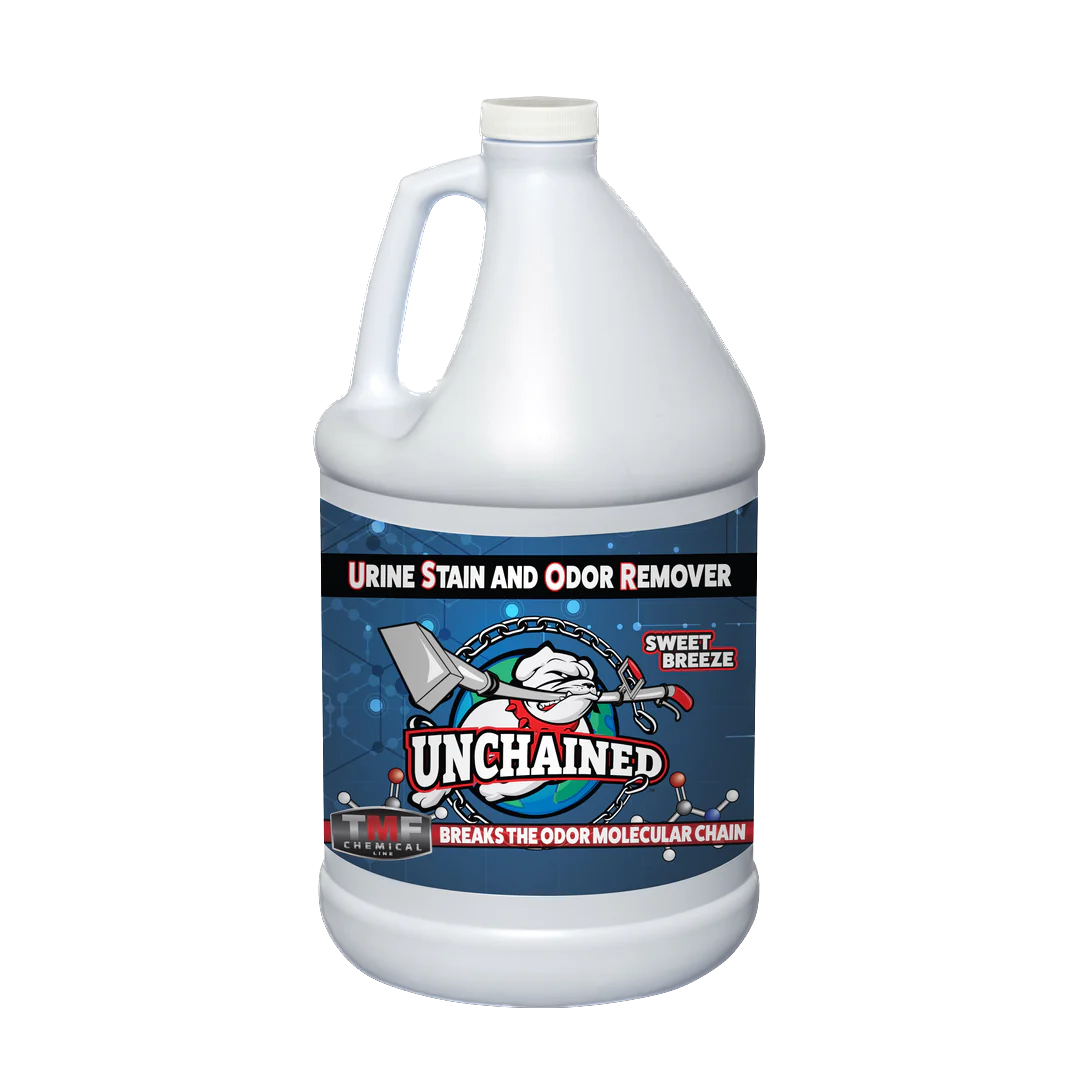
Products that perform well for this application include USOR Unchained, which combines enzyme action with an odor neutralizer specifically formulated for urine, and BioPro 10K, an extreme-strength enzyme prespray used by professional cleaners on heavily contaminated surfaces. First-time buyers may prefer the standard-size version of USOR Unchained, while professional users may find USOR Unchained 55 Gallon Drum more economical for large-scale use. All are available from TMF Store's urine removal collection.
After dwell time, blot up the cleaner with clean cloths. Do not rinse with excess water - use as little rinse water as possible on wood to prevent warping.
Step 4 - Follow with Baking Soda for Surface Odor
After the enzyme cleaner has been removed and the surface is slightly damp, sprinkle a generous layer of baking soda over the treated area. Baking soda's high pH neutralizes any remaining acidic odor compounds on the surface and absorbs residual moisture. Leave it for a minimum of 8 hours - overnight is ideal. Cover it with a light towel if you have pets or children to prevent disturbance.
In the morning, sweep or vacuum the baking soda thoroughly. This step is particularly useful after enzyme treatment on wood furniture, where you want to pull any remaining surface odor before the piece dries completely.
Note: baking soda alone is not sufficient for deep or old stains. It addresses surface-layer odor but cannot reach or break down uric acid crystals embedded in the wood grain. Use it as a finishing step after enzyme treatment, not as a standalone solution.
Step 5 - Dry Thoroughly and Ventilate
Incomplete drying is one of the most overlooked contributors to recurring odor. Moisture left in wood fibers creates ideal conditions for the uric acid crystals to reactivate. After treatment, open windows and run a fan directed at the treated surface to accelerate air circulation. For floors, a dehumidifier in the room during the 24 hours following treatment will reduce ambient moisture and speed the drying process.
Do not place rugs, furniture, or any covering back over the treated area until it is completely dry - typically 12-24 hours depending on wood type and ambient humidity.
DIY Methods That Can Help (and Their Limits)
DIY methods using vinegar, hydrogen peroxide, and baking soda can address fresh, surface-level dog pee smell on wood - but none of them eliminate uric acid crystals, which means odor will return on humid days or with repeat accidents. They are useful for immediate response or mild incidents, but should not be relied on for deep stains or repeated soiling.
White Vinegar and Water Solution
Mix equal parts white vinegar and warm water in a spray bottle. Apply to the affected area, let sit for 5-10 minutes, and blot dry. Vinegar's acidity neutralizes some of the alkaline compounds in dried urine and temporarily suppresses the ammonia smell.
The limitation is significant: vinegar does not penetrate wood grain effectively, cannot break down uric acid crystals, and used repeatedly can dull or damage some wood finishes. Always do a patch test on an inconspicuous area first. Do not mix vinegar with hydrogen peroxide - this creates peracetic acid, which is corrosive and can damage wood finish and skin.
Hydrogen Peroxide with Dish Soap
Mix 3% hydrogen peroxide (standard pharmacy grade) with a small amount of dish soap. Apply to the stain with a cloth, let sit for 10 minutes maximum, then blot and rinse lightly. Hydrogen peroxide has mild oxidizing properties that can lighten urine stains and suppress odor compounds.
Use this method with caution on darker wood or stained surfaces - hydrogen peroxide can bleach or lighten wood if left too long or used at too high a concentration. Never leave it on for more than 10 minutes and keep it away from lacquered or oiled finishes where the oxidizing action can strip the protective layer.
Baking Soda Alone
Baking soda absorbs surface moisture and neutralizes acidic odor compounds through its alkaline chemistry. Sprinkle liberally over a damp area, leave overnight, and vacuum in the morning. It is safe on virtually all wood surfaces and furniture finishes.
However, baking soda works only at the surface level. It cannot reach uric acid crystals 2-3mm into wood grain, and it provides no enzymatic breakdown of organic matter. Consider it a deodorant, not a treatment.
Why DIY Methods Fall Short on Deep or Old Stains
The fundamental chemistry problem is this: uric acid is water-insoluble and binds to surfaces at a molecular level. Vinegar (an acid) and baking soda (a base) neutralize other odor compounds, but neither has the enzymatic capacity to break the molecular bonds holding uric acid crystals to wood fiber. Only biological enzyme cleaners contain the specific enzymes - primarily uricase - that catalyze the breakdown of uric acid into soluble compounds that can be rinsed away.
For any stain older than 24 hours, any accident on unsealed wood, or any situation where the smell has already returned after a previous cleaning attempt, enzyme treatment is not optional - it is the only effective path.
How to Get Old Dog Pee Smell Out of Wood
Old, set-in dog urine smell in wood requires extended enzyme treatment, more dwell time, and potentially multiple applications - and in cases of heavy long-term soiling, sanding and refinishing may be the only permanent solution. The longer urine has been in the wood, the deeper the crystals are embedded, and the more treatment passes are required.

Identifying How Deep the Urine Has Penetrated
Before choosing a treatment approach, assess penetration depth. Scan the area with a UV light - the intensity and size of the glow gives you a rough sense of the saturation level. Dark staining visible in normal light (often appearing gray or black on hardwood) indicates the urine has reacted with the wood's natural tannins and penetrated past the finish into the grain. This is a sign that surface treatment alone will not resolve the problem.
Press a dry paper towel firmly against the stain - if the towel picks up any yellow tint after 30 seconds, moisture and active compounds are still present. If the stain is bone dry and dark, you are dealing with old embedded crystals that will require an extended enzyme soak.
Extended Enzyme Soak Method
For old stains, apply enzyme cleaner generously and use the wet cloth or plastic wrap covering technique described in Step 3. Instead of 15-30 minutes of dwell time, extend to 45 minutes to 1 hour, checking periodically that the surface hasn't over-saturated. On wood floors, lay a damp cloth over the treated area after applying the enzyme cleaner - this keeps the product from evaporating and maintains enzyme activity throughout the full dwell period.
Expect to repeat the process 2-3 times over consecutive days for heavily soiled areas. After each treatment, dry the surface completely before re-applying. Rushing to re-treat while the wood is still wet dilutes the enzyme concentration and reduces effectiveness.
For deep-soiled furniture or floors, check out our full range of pet odor and stain removal products formulated specifically for these scenarios.
When Sanding and Refinishing Is the Only Fix
If the dark staining covers a large area, the smell returns after three or more enzyme treatments, or the urine has visibly warped or discolored the wood, you are past the point of surface treatment. In this situation, the uric acid crystals are embedded too deeply in the wood fiber for any topical cleaner to reach effectively.
The professional approach: sand down to raw wood, removing the stained layer entirely, then apply a stain-blocking primer or shellac-based sealer to lock in any residual odor compounds before refinishing. If the urine has reached the subfloor, the subfloor boards in the affected area may need to be replaced before refinishing the top floor.
This is the scenario where calling a professional cleaning or restoration company makes clear financial sense - a floor refinish is expensive, and a professional who misses residual uric acid in the subfloor before sealing will trap the odor under the new finish permanently.
Dog Pee Smell in Wood Furniture vs. Wood Floors - Key Differences
Dog pee smell treatment differs between wood furniture and wood floors primarily in how much liquid you can safely use, how accessible the affected area is, and whether a subfloor or interior cavity is involved. The chemistry is identical - both require enzyme treatment - but the application method and risks differ.
The table below compares the treatment approach for the three most common wood surface types.
The following table shows treatment differences across surface types. Use it to match your specific situation to the right approach before starting.
|
Surface Type |
Penetration Risk |
Recommended Cleaner |
Water Use |
Special Consideration |
|
Sealed hardwood floor |
Low-medium (if treated fast) |
Enzyme cleaner |
Minimal |
Urine travels between boards to subfloor |
|
Unsealed/unfinished floor |
High |
Enzyme cleaner - extended soak |
Minimal - use sparingly |
May require sanding if deeply embedded |
|
Lacquered wood furniture |
Low (if treated fast) |
Enzyme cleaner + soft brush |
Minimal |
Test on hidden area; finish can be damaged |
|
Unfinished/antique furniture |
Very high |
Enzyme cleaner - repeat applications |
Minimal |
Risk of permanent staining; sanding may be needed |
Matching surface type to the right approach prevents wood damage while maximizing odor removal effectiveness.
Treating Finished Wood Furniture
Fresh accidents on lacquered, varnished, or polyurethane-finished furniture are the most manageable scenario. Blot immediately, then apply enzyme cleaner with a soft sponge or cloth - avoid saturating the wood. Work the cleaner gently into any grooves or carved areas where urine pools. Let it dwell for 15 minutes, blot dry, then follow with baking soda overnight.
For older stains on furniture, particularly on chair legs or table bases where accidents can go unnoticed, the extended enzyme soak method (covered above) applies. Cover the treated area with a damp cloth for up to an hour. The confined surface area of furniture means enzyme cleaner concentration remains higher for longer compared to a floor application, which improves results.
Treating Hardwood Floors (Sealed vs. Unsealed)
Sealed hardwood floors give you a small window - typically 5-10 minutes - before urine breaches the finish and enters the grain. Act fast on sealed floors and enzyme treatment is usually sufficient in one or two passes. The biggest additional risk on floors is urine traveling through the gaps between boards and pooling on the subfloor below - use your UV light to check the perimeter of the stain carefully.
Unsealed floors require more caution with liquid volumes. Apply enzyme cleaner sparingly but consistently across the affected area, using a cloth or brush rather than pouring directly. Excess liquid on unsealed wood causes swelling and warping, which compounds the damage significantly.
Subfloor Treatment When Urine Has Soaked Through
If UV inspection reveals staining that has spread beyond the visible top surface, or if the smell is strongest at the seams between boards, urine has likely reached the subfloor. This is common in older homes where hardwood finish is worn, and in areas of repeated accidents.
To treat the subfloor without lifting the floor, use a syringe or dropper to inject enzyme cleaner into the gaps between boards, working methodically across the affected area. Allow maximum dwell time - 60 minutes minimum - and repeat the treatment the following day. If the smell persists after two subfloor treatments, the subfloor boards themselves may need to be addressed by a professional. You can read more about urine removal from wood floors in our detailed guide on how to remove urine odor from wood floors.

Mistakes That Make Dog Pee Smell Worse
Several common cleaning instincts actively worsen dog urine odor on wood - the most damaging being the use of ammonia-based cleaners and steam, both of which chemically set the odor deeper into the wood. Knowing what to avoid is as important as knowing the right technique.
-
Using ammonia-based cleaners: Ammonia is a component of dog urine. Cleaning with ammonia-based products both amplifies the existing smell and chemically signals to your dog that the spot is an established bathroom location, virtually guaranteeing repeat accidents in the same area.
-
Rubbing instead of blotting: Rubbing spreads urine laterally, increases the surface area of contamination, damages wood grain on softer woods, and pushes liquid deeper into the fiber. Always press and lift vertically.
-
Using steam or hot water before enzyme treatment: Heat causes uric acid to bond more strongly to wood fibers - the same chemistry that makes a protein stain permanent if you wash it in hot water. Never steam-clean a urine-affected area or apply hot water until enzyme treatment has fully broken down the uric acid. This is a particularly important caution for those using steam mops on hardwood floors.
-
Over-saturating wood with liquid: Wood swells and warps when exposed to excess moisture. Use the minimum amount of any cleaning liquid needed - enough to match the penetration depth of the urine, no more. The goal is targeted treatment, not flooding.
-
Applying bleach: Bleach oxidizes and can lighten or damage wood finishes and kill the wood's natural appearance. It does not break down uric acid, and the oxidation it causes can permanently alter the wood color around the stain.
-
Treating only the visible stain: As covered in Step 2, the visible stain area is almost always smaller than the actual contaminated area. Treating only what you can see leaves active uric acid sources just outside the treated zone - and the smell will return from exactly those untreated edges.
How to Stop Your Dog From Returning to the Same Spot
Once uric acid is fully eliminated - confirmed by a clean UV scan - your dog has no scent cue remaining. But a few additional steps reinforce the change. Keep the area clean and dry in the weeks after treatment. Consider using a dog-safe deterrent spray in the area while you reinforce house-training. For puppies or dogs with incontinence, protective covers on furniture and floor runners in high-traffic zones reduce the frequency and severity of accidents.
Training is the permanent solution. Dogs that have a consistent outdoor bathroom routine and are supervised indoors during the house-training phase rarely develop habitual indoor accidents. For older dogs with medical causes of incontinence, a veterinary consultation is the appropriate first step before any behavioral intervention.
When to Call a Professional Cleaner
Call a professional when odor returns after three full enzyme treatment cycles, when UV inspection reveals staining that extends under baseboards or covers an area larger than 4 square feet, or when visible wood discoloration indicates deep tannin damage. These are signals that the contamination has exceeded what surface treatment can address.
Professional cleaners have access to commercial-grade enzyme products at concentrations higher than retail versions, truck-mount extraction equipment that can inject and immediately extract product from wood and subfloor simultaneously, and industrial-grade UV scanning equipment. The combination allows for deeper penetration and more complete extraction than any DIY process can achieve.
At TMF Store, professional cleaners and serious DIYers can access the same commercial-grade urine removal chemicals used in the field - including the full pet odor and stain removal collection. For guidance on tackling a full urine treatment job on furniture specifically, see our detailed guide on getting dog urine out of wood furniture.
Frequently Asked Questions
Why does dog pee smell keep coming back on wood floors even after cleaning?
The smell returns because standard cleaners remove liquid but leave uric acid crystals embedded in the wood grain. These crystals reactivate when exposed to humidity, releasing ammonia gas. Only enzyme cleaners break down uric acid at the molecular level, permanently eliminating the source of the odor.
Does dog urine permanently damage hardwood floors?
It can. Prolonged exposure causes uric acid to react with wood tannins, producing deep black or gray staining that is chemically embedded in the grain. If caught early and treated with enzyme cleaner, permanent damage is avoidable. Old, heavily saturated stains may require sanding and refinishing to fully resolve.
What is the best cleaner for dog urine on hardwood floors?
A professional-grade enzyme cleaner is the most effective option - products like USOR Unchained or BioPro 10K break down uric acid crystals that DIY methods leave behind. Hydrogen peroxide with dish soap works as a secondary option for fresh stains on sealed floors, but should not be left on for more than 10 minutes to avoid bleaching.
Can you use white vinegar on hardwood floors to remove dog urine?
Vinegar works as a temporary odor suppressant for fresh accidents on sealed floors, but it cannot eliminate uric acid crystals and repeated use can dull polyurethane finishes. It is a short-term measure only - enzyme treatment is needed for complete removal, especially on any stain older than a few hours.
How do you get old dog urine smell out of wood that has dried?
Apply enzyme cleaner generously to the affected area identified with a UV light, cover with a damp cloth to prevent evaporation, and allow 45-60 minutes of dwell time. Repeat daily for 2-3 days. If the smell persists after three treatments, the urine has likely penetrated to the subfloor or deeply into the grain - at that point, sanding and refinishing or professional extraction is needed.
How long does it take for dog urine smell to go away from wood floors?
With proper enzyme treatment, fresh accidents are resolved within 24-48 hours including drying time. Old or deep stains require 3-7 days across multiple treatment cycles. Smell that persists beyond a week of proper enzyme treatment indicates untreated uric acid is still present - likely in the subfloor or in areas the UV scan missed.
Is baking soda enough to remove dog pee smell from wood? No. Baking soda neutralizes surface odor compounds and absorbs moisture, but it cannot reach or break down uric acid crystals embedded in the wood grain. Use it as a finishing step after enzyme treatment - not as a standalone solution for any stain that has had time to penetrate the surface.
Conclusion
Dog pee smell in wood is a chemistry problem, and it requires a chemistry solution. Enzyme cleaners - applied with proper dwell time and guided by UV detection - are the only method that eliminates uric acid crystals permanently. DIY methods manage surface odor but leave the root cause intact, which is why the smell keeps returning. Act fast on fresh accidents, go deep on old ones, and dry completely. For the right products to get the job done, explore our full pet odor and stain removal collection or contact the team at TMF Store for professional-grade guidance.